HomeAbout CCATObservatoryScienceEventsMultimediaDocuments

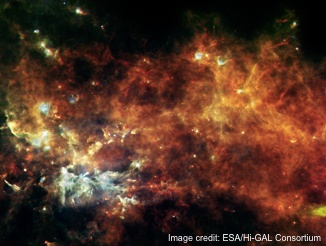
Herschel submillimeter continuum image the Milky Way galaxy in Vulpecula

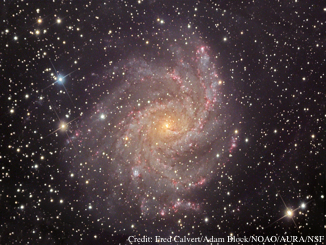
NGC 6946 in the visible - a nearby "Grand Design" spiral galaxy

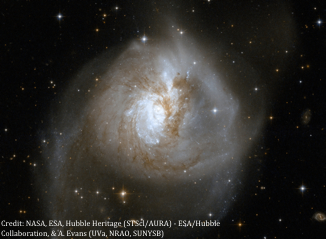
Visible image of a pair of colliding galaxies collectively called NGC 3256

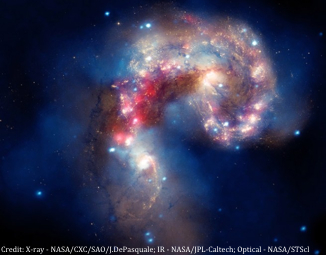
Composite visible and infrared view of the colliding galaxies, NGC 4038/NGC 4039, which make up the "Antennae" system

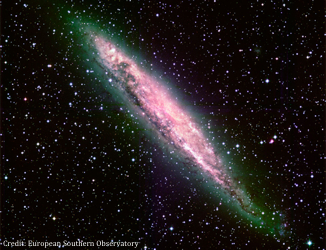
NGC 4945 - A spiral galaxy, seen nearly edge-on, undergoing vigorous star formation activity

1/5

Science Cases


CCAT will have an unprecedented capability to make deep, large-area multi-wavelength submillimeter surveys that address the following key astrophysical problems.

Galaxy Formation and Evolution

CCAT will detect hundreds of thousands of high-redshift submillimeter starburst galaxies.  The star formation history of the universe, the evolution of the submillimeter galaxy luminosity function, and the comoving number density and clustering of submillimeter galaxies will be measured.

Dark Matter and Dark Energy

CCAT’s high resolution images of the Sunyaev-Zel’dovich effect in hundreds of clusters of galaxies will show how clusters form and evolve, aiding the determination of the dark energy equation of state and other cosmological parameters.

Star Formation

CCAT will provide a comprehensive census of cold, dense molecular cores that collapse to form stars.  In nearby clouds, CCAT will determine how the core mass function is related to the stellar mass function, down to brown dwarf masses.  Heterodyne array receivers on CCAT will trace how gas flows from large-scale diffuse clouds, to filaments, and finally to star-forming cores.

Protoplanetary and Debris Disks

CCAT will survey nearby young star clusters to determine the prevalence and evolution of protoplanetary and debris  disks, identifying targets for high-resolution imaging  with ALMA.

The Kuiper Belt and Comets

CCAT will determine basic physical data – sizes and albedoes – for hundreds of Trans-Neptunian Objects (TNOs) and enable study of the origin of the Earth’s oceans by measuring deuterium abundances in comets.